














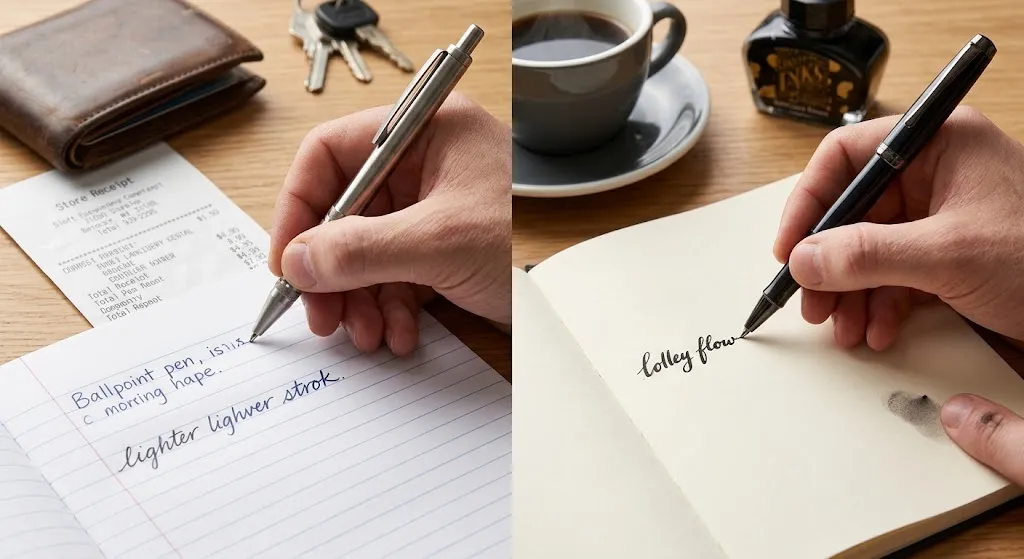
You are standing in the stationery aisle, staring at a wall of sleek, identical-looking pens. You grab two that appear virtually indistinguishable, uncapping both to scribble a quick test on a scrap of paper. One glides effortlessly, laying down a rich, dark line with almost zero effort. The other feels slightly firmer, requiring a tiny bit of muscle, but its line dries instantly without a single smudge.
What you have just experienced is the fundamental divide in the pen world: the battle between the ballpoint and the rollerball.
While both pens rely on a tiny, rotating tungsten carbide ball in their tips to transfer ink onto paper, they are completely different instruments under the hood. The core distinction comes down to the ink inside them. Ballpoint pens use a thick, oil-based ink that prioritizes durability and quick drying. Rollerball pens use a thin, fluid water-based or gel ink designed for effortless gliding and vivid lines. Choosing between them isn’t about finding which pen is objectively “better”—it is about discovering which tool matches your physical writing style, your daily environment, and your personal taste.
At a Glance: The Core Difference Between Ballpoint and Rollerball Pens
Think of the difference between these two pens like the difference between painting with thick paste versus watercolor.
| Feature | Ballpoint Pen | Rollerball Pen |
| Ink Base | Oil-based (Thick/Viscous) | Water or Gel-based (Fluid) |
| Writing Pressure | Moderate to Heavy | Ultra-Light / Zero Pressure |
| Drying Speed | Instant (1–2 seconds) | Slow (5–15 seconds) |
| Bleed-Through | Virtually None | Common on thin paper |
| Paper Choice | Standard, Receipts, Glossy | Premium, Thick, Porous |
| Maintenance | Extreme (Never dries out) | Capped (Prone to drying) |
If you need a pen that can sit at the bottom of a backpack for six months, write on a slick store receipt, and never leak in your pocket, you want a ballpoint. If you write long journal entries, suffer from hand fatigue, or crave the expressive liquid line of a fountain pen without the mess, you want a rollerball.
How Ballpoint Pens Work: The Low-Maintenance Workhorse
Oil-Based Ink Mechanics
The ballpoint pen, patented in its modern commercial form by László Bíró in 1938, was designed to solve a very specific problem: fountain pens were messy, leaked on airplanes, and took too long to dry. Bíró noticed that the heavy ink used in newspaper printing presses dried almost instantly on contact with paper. He miniaturized that paste-like, oil-based ink formula and paired it with a microscopic ball socket mechanism.
Inside a ballpoint cartridge, the ink is surprisingly thick—almost like a dense paste or heavy syrup. The tiny metal ball acts as a buffer, sealing the ink reservoir from the outside air. As you drag the pen across a page, the friction rolls the ball. The ball picks up the sticky oil ink from the internal reservoir, coats its own surface, and transfers that ink onto the paper fiber. Because the ink is oil-based, it relies entirely on physical friction to roll out, rather than liquid gravity.
Key Characteristics and Writing Experience
Writing with a classic ballpoint demands a tangible physical engagement. Because the ink is so viscous, you have to push down slightly to get the ball rolling smoothly. This creates a tactile, controlled feel. You can feel the textured surface of the paper underneath your grip.
Because the ink flow relies on friction, ballpoints offer unmatched precision over shading and line density. Push down hard, and you get a dark, solid line. Lighten your hand, and you get a delicate, faint stroke. Artists often favor traditional ballpoints for this exact reason, using them like colored pencils to create intricate, cross-hatched illustrations.
Pros and Cons of Ballpoint Pens
The true beauty of a ballpoint lies in its bulletproof reliability.
- Pro: Incredible Ink Longevity. A single ballpoint refill can last for miles of writing. The paste-like ink burns through far slower than liquid inks.
- Pro: Smudge-Proof Performance. The oil formula dries nearly instantly upon contact with paper, making it virtually immune to accidental hand smears.
- Pro: Write Anywhere Versatility. Ballpoints perform admirably on cheap notebook paper, carbon copy forms, shiny receipts, and even glossy plastic labels.
- Con: Required Hand Pressure. Pressing down continuously can cause cramping during long writing sessions.
- Con: Occasional Ink “Gooping.” Cheap ballpoints tend to accumulate small blobs of thick ink around the tip, which can dump onto your paper in an unsightly smudge.
- Con: Muted Colors. Oil-based inks generally lack the electric vibrancy of liquid-based pigments.
How Rollerball Pens Work: The Fluid Fine-Writer
Water-Based and Gel Ink Mechanics
Introduced in the late 1960s as a bridge between the convenience of a ballpoint and the luxury of a fountain pen, the rollerball uses the exact same mechanical ball-and-socket tip design. However, the substance sitting behind that ball is entirely different.
Rollerball pens carry a low-viscosity, water-based ink (or a suspended gel ink formula). This ink is thin, highly liquid, and flows with minimal physical resistance. Instead of relying heavily on friction to scrape paste out of the tube, a rollerball relies on capillary action. The moment the wet metal ball touches porous paper fibers, the paper pulls the liquid ink right out of the pen.
Key Characteristics and Writing Experience
If writing with a ballpoint is like driving a sturdy truck down a gravel road, writing with a rollerball is like ice skating on fresh rink surface. The pen floats.
Because the ink liquid flows so freely, your hand can barely graze the page, and the pen will still leave a dark, saturated, unbroken line. The color saturation of water-based rollerball inks is dramatically rich. Black inks look like deep India ink; blues look like vibrant oceans. The line is dark, crisp, and velvety, elevating messy handwriting into something that looks intentionally bold.
Pros and Cons of Rollerball Pens
The rollerball offers an unmatched writing sensation, but that luxury comes with clear trade-offs.
- Pro: Zero-Effort Ergonomics. The pen requires almost zero pressure, making it an incredible relief for writers struggling with arthritis, joint pain, or wrist strain.
- Pro: Gorgeous Saturated Lines. Liquid ink leaves a vivid, professional mark that makes signatures pop and notes easy to skim.
- Con: Slow Dry Times. Liquid ink needs time to soak into the paper fibers, meaning quick movements can drag your palm across wet ink and smear your work.
- Con: High Bleed-Through Risk. The liquid nature of the ink means it quickly saturates thin or cheap paper, feathering outward into fuzzy text or soaking straight through to the back of the page.
- Con: Rapid Ink Consumption. Rollerballs burn through their ink cartridges significantly faster than ballpoints.
- Con: Cap Dependency. Leave a water-based rollerball uncapped on your desk for an hour, and the exposed tip will dry into a useless lump of metal.
Head-to-Head Comparison: Ballpoint vs. Rollerball
| Comparison Area | Ballpoint | Rollerball |
| Viscosity & Flow | Paste-like oil | Fluid water/gel |
| Ink Delivery | Friction required | Capillary action |
| Dry Time | Dries in 1–2 sec | Takes 5–15 sec |
| Paper Performance | No bleed-through | Feathers/bleeds |
| Overall Feel | High control | Smooth, effortless flow |
Ink Flow and Drying Time
The physical science of the ink controls everything here. Ballpoint ink acts like a wax-oil hybrid; it sets almost the millisecond it hits the page. You can drag your thumb across a freshly drawn ballpoint line instantly without ruining your document.
Rollerball ink is a true liquid. It must physically absorb into paper cellulose and evaporate to set. On high-quality, dense paper, this process can take anywhere from 5 to 15 seconds. If you write fast or constantly close your notebook right after taking notes, a rollerball will test your patience with wet smears.
Writing Pressure and Ergonomics
Ballpoints require physical down-force. If you hold a ballpoint lightly and drag it across a page using only its own weight, it likely won’t leave a mark at all. That physical resistance requires a firmer grip, which engages your forearm and fingers.
Rollerballs require virtually no down-force. If you rest a rollerball on a sheet of paper and gently drag it by the tail, it will lay down a dark line under its own weight. For anyone putting in multi-hour study sessions or writing extensive manuscript drafts, the rollerball wins hands-down for physical comfort.
Paper Compatibility and Bleed-Through
Put a rollerball pen up against a cheap piece of copy paper, a sticky note, or thin newsprint, and you will see the liquid ink feather out into miniature spiderwebs around your letters. Worse, it will leak straight through to the other side, ruining the next page.
Ballpoint ink sits comfortably on top of paper fibers rather than drowning them. It ignores poor-quality paper and excels on non-porous surfaces. Need to fill out a carbon copy invoice, sign the back of a slick credit card, or write on waterproof rite-in-the-rain paper? A ballpoint is your only reliable option.
Longevity and Ink Consumption
Because a rollerball drenches the page to create its signature rich line, it empties its reservoir rapidly. You might find yourself replacing a rollerball refill every few weeks during heavy use.
A ballpoint dispenses its thick ink with extreme stinginess. A single standard ballpoint cartridge can easily sit inside your desk drawer for five years, functioning perfectly the moment you pick it up, and outlasting three to four equivalent rollerball refills.
Practical Applications: Which Pen Should You Choose?
Best Uses for Ballpoint Pens
The ballpoint is your ultimate operational tool for unpredictable environments. Keep a ballpoint close for:
- Everyday Carry (EDC) & Travel: Pocket notebooks, field work, glove compartments, and purses where pens are subject to temperature swings and extended neglect.
- Official Documentation: Filling out carbon-copy forms, writing checks, or signing slick receipts where liquid ink simply smudges away.
- Fast-Paced Office Work: Rapidly scribbling shorthand notes, marking up physical printouts, or completing forms at high speed.
- Artistic Sketching: Creating detailed, shaded ballpoint drawings that require fine control over tonality and line weight.
Best Uses for Rollerball Pens
The rollerball is your expressive tool for controlled, comfortable environments. Reach for a rollerball during:
- Journaling and Creative Writing: Long-form notebook sessions where hand comfort and fluid expression matter most.
- Executive Signatures: Signing important contracts, formal letters, or certificates where you want your ink to look rich and commanding.
- Desk Duty: Daily office note-taking on thick, high-quality notebook paper where the pen sits safely capped between thoughts.
Left-Handed Writers: What You Need to Know
Left-handed writers face a unique challenge: as your hand moves left to right across the page, your palm naturally drags directly over the words you just wrote.
For lefties, the traditional water-based rollerball can be a nightmare. Because liquid ink stays wet on the page for several seconds, a left-handed writer’s palm will smudge the line into a messy smear across the page, leaving blue or black ink stains on the side of their hand.
If you are left-handed and want to write smoothly:
- Stick to modern ballpoint pens: Quick-drying oil ink ensures your palm stays clean.
- Opt for Hybrid or Fast-Drying Gel Pens: If you want the smooth feel of a rollerball without the mess, choose specialized quick-dry gel inks designed specifically to dry in under a second.
Top Recommended Models for Every Writing Style
Iconic Ballpoint Pens Worth Buying
- Fisher Space Pen Bullet: The undisputed king of Everyday Carry. Its pressurized oil-ink cartridge allows it to write upside down, over grease, in freezing temperatures, and under water.
- Lamy 2000 Ballpoint: A masterclass in Bauhaus design. Crafted from fiberglass and brushed stainless steel, it offers a sophisticated, weighted ballpoint experience for professional settings.
- Bic Cristal: The humble classic. It costs pennies, lasts for miles, and proves that simple oil-based ink mechanics can change the world.
- Uni Jetstream: The ultimate modern evolution of the ballpoint. It uses a low-viscosity hybrid oil ink that glides far smoother than a traditional ballpoint while retaining instantaneous dry times.
Standout Rollerball Pens Worth Trying
- Lamy Swift Capless Rollerball: An engineering marvel that retracts its pocket clip when you extend the tip, giving you smooth liquid ink performance without the hassle of a traditional cap.
- Pilot Precise V5 / V7: The classic liquid-ink rollerball featuring a visible ink supply and a needlepoint tip for razor-sharp, dark, fluid writing.
- SCHMIDT Safety Ceramic Rollerball Refill (3888 / 888): The gold standard refill used inside countless high-end luxury pen bodies. It offers fountain-pen-level richness with absolute consistency.
- Uniball Vision Elite: Designed specifically not to leak under atmospheric pressure changes, making it the rare liquid rollerball that you can safely take on an airplane.
Making the Right Choice for Your Daily Carry
Choosing the right writing instrument isn’t about finding the most expensive tool—it is about matching the mechanics of the pen to the reality of your day.
If your day involves quick notes on cheap paper, signing receipts, tossing your pen into a bag, and needing absolute, bulletproof reliability, buy a quality ballpoint. It won’t bleed, it won’t smudge, and it will never let you down when you need to sign on the dotted line.
If your day revolves around deep work at a desk, personal journaling, filling high-grade notebooks, or protecting your hands from cramp and fatigue, buy a rollerball. The effortless glide and deep, rich line will make every word feel like an intentional, satisfying craft.
Test both, listen to how your hand feels after a full page of writing, and build a pen collection that serves your style.